
As the space industry moves towards reusable launch systems and longer-duration missions, engineers face a persistent challenge: how to maintain lightweight composite structures that are repeatedly exposed to extreme mechanical and thermal loads
A new European research project may offer a solution. By combining advanced composite materials, embedded sensing technologies and integrated heating systems, researchers have demonstrated a structural material capable of detecting damage and autonomously repairing itself. The technology has the potential to improve the durability of future spacecraft while reducing maintenance requirements and operational costs.
Developed through a collaboration between Swiss companies CompPair and CSEM, Belgian sensing specialist Com&Sens and the European Space Agency (ESA), the project represents a significant step towards intelligent spacecraft structures that can monitor their own condition and recover from damage without external intervention.
ADDRESSING A GROWING CHALLENGE IN SPACE TRANSPORTATION
Composite materials are increasingly becoming the material of choice for spacecraft structures. Carbon fibre reinforced polymers offer a combination of low weight, high strength and corrosion resistance that is difficult to match with metallic alternatives.
However, while composites deliver significant performance benefits, they also present unique maintenance challenges. Repeated launch cycles, cryogenic conditions, vibration, impacts and thermal stresses can all generate small defects that may grow over time. For reusable launch vehicles and future space transportation systems, these issues become particularly important. Inspection, repair and refurbishment activities can add significant cost and complexity between missions, potentially limiting the economic benefits of reusability.
To address this challenge, CompPair developed HealTech, a composite material designed to repair damage through a controlled heating process. The material contains a healing agent embedded within the composite matrix that can be reactivated when required. Rather than replacing damaged structures or conducting extensive repair operations, engineers can apply heat to the affected area, allowing the material to restore itself and recover mechanical performance.
FROM SELF-HEALING MATERIAL TO INTELLIGENT STRUCTURE
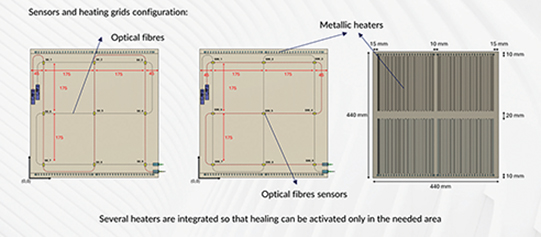
This latest development takes the concept significantly further. Under Project Cassandra—short for Composite Autonomous SenSing AnD RepAir—the research team integrated a network of fibre-optic sensors directly into the HealTech composite material. These sensors continuously monitor the condition of the structure and identify the location of emerging damage. Once damage is detected, integrated heating elements activate the repair process automatically.
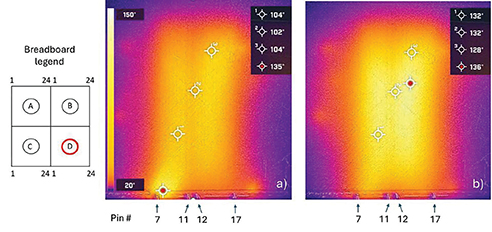
The prototype combines several advanced technologies within a single structural component. Fibre-optic sensor networks provide continuous health monitoring, while integrated 3D-printed aluminium heating grids deliver controlled heating to the affected area. The material is heated to between 100°C and 140°C, activating the healing agent contained within the composite resin.
The result is a structure capable of both identifying damage and initiating its own repair process. This combination of structural health monitoring and autonomous repair has long been a goal for aerospace engineers seeking to improve reliability while reducing maintenance requirements.
DEMONSTRATING PERFORMANCE UNDER SPACE CONDITIONS
To evaluate the concept, the project team produced a series of test articles ranging from small samples measuring 2cm by 10cm to larger demonstrator panels measuring 40cm by 40cm. Testing focused on three key areas: damage detection capability, heating uniformity and repair effectiveness.
Researchers also conducted thermal shock testing to assess how the material responds to conditions representative of cryogenic fuel tanks. These tests are particularly relevant for launch vehicle applications, where structures can experience rapid and extreme temperature fluctuations during operation.
The successful demonstration suggests the technology may be suitable for larger spacecraft structures, including propellant storage systems. The next phase of development will focus on scaling the technology to larger geometries, with researchers targeting a complete cryogenic fuel tank as a future demonstrator. For spacecraft designers, the ability to integrate sensing, diagnostics and repair functions directly into structural components could fundamentally change how future vehicles are designed, maintained and certified.
SUPPORTING REUSABLE LAUNCH SYSTEMS
The emergence of reusable launch vehicles has transformed the economics of space transportation. However, achieving rapid turnaround between missions remains a significant engineering challenge.
Structural inspection and maintenance activities continue to account for a substantial portion of refurbishment effort. Technologies capable of reducing these requirements could therefore have a major impact on operational efficiency.
Bernard Decotignie of ESA believes the technology could play an important role in future transportation architectures: “Implementing this technology into our systems could have enormous benefits for space transportation. It will help develop reusable space infrastructure and reduce mission costs. This really proves what European innovation can do for the space sector.”
The environmental benefits are also noteworthy. Extending component life and reducing the need for replacement hardware could help minimise material waste associated with future space programmes.
FROM SCIENCE FICTION TO REALITY
For CompPair, the project demonstrates how advanced materials can move beyond passive structural functions to become active participants in vehicle health management.
“I’m excited by the autonomy and durability benefits we can bring for the future spacecrafts and launchers, closing the gap between science-fiction and reality!” says CompPair chief technology officer Robin Trigueira. “This project is a major step for CompPair in the space sector, HealTech is unlocking unprecedented technological advancement for composite material health monitoring and management, clearly highlighting the possibilities brought by healable composites for reusable space structure costs efficiency.”
The ability to combine sensing, diagnostics and repair capabilities within a lightweight composite system could open new possibilities not only for launch vehicles but also for satellites, orbital infrastructure and future deep-space missions.
Looking ahead, CompPair’s head of research and development, Cecilia Scazzoli, sees broad potential for the technology in demanding aerospace applications: “I’m thrilled that we have demonstrated that HealTech composites with health monitoring and heating systems show autonomous damage sensing and healing and high resistance to micro-cracking. This makes them suited to the demanding requirements of propellant tanks and reusable space structures, and paves the way for lighter, more maintainable spacecraft components.”