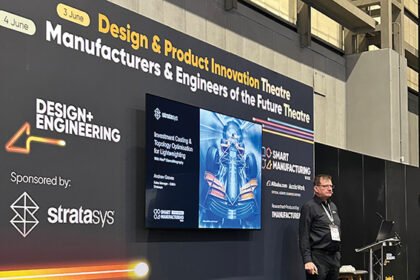

The drive to reduce weight while maintaining performance continues to shape engineering decisions across aerospace, motorsport and other high-performance industries
Generative design and topology optimisation have emerged as powerful tools for achieving significant mass reduction without sacrificing structural integrity. However, manufacturing the resulting geometries can present a major challenge.
According to Andrew Graves, sales manager at Stratasys, the demand for lightweight components is particularly acute in sectors where every gram matters. He explains: “Motorsport, aerospace, lots of other industries require lightweight metal components,” and notes that topology optimisation makes it possible to “take away a lot of metal from the part that you don’t actually need.”

NO NEED TO COMPROMISE ON PERFORMANCE
Topology optimisation enables engineers to remove unnecessary material while retaining critical load-bearing functionality. As Graves explains, “it’s a way of lightweighting components, but without compromising any of their structural integrity, so you get the same load-bearing capabilities.”
The process begins with a conventional design before software identifies where material can be removed. The result is often a highly organic geometry that would be difficult to create using traditional manufacturing methods.
Describing the outcome, Graves says: “You start off with a design, and that will work fine, but if you lightweight it using topology optimisation, you get a part that will withstand all the same loads, all the same load-bearing capability, same connection points, but its mass would be far less than the original design.”
The benefits are particularly valuable in applications such as motorsport braking systems, where reducing unsprung mass can improve vehicle dynamics. Referring to a topology-optimised brake calliper, Graves notes that, “most of the metal work that doesn’t need to be there has been removed by a software package.”
THE MANUFACTURING CHALLENGE
While generative design delivers impressive weight savings, it often creates geometries that are difficult or impossible to manufacture using conventional techniques. “Lead times for these can be weeks or months, or even impossible to make,” says Graves.
Complex internal channels and inaccessible features can limit the suitability of CNC machining. Even advanced metal additive manufacturing processes can introduce challenges. Graves points out that metal 3D printing, “is a very specialised area of 3D printing,” adding that, “it is expensive if you’re setting it up in house, especially for industrial metal 3D printing.”
Traditional investment casting also has limitations. For highly optimised geometries, tooling can become impractical.
COMBINING TOPOLOGY OPTIMISATION WITH SLA-BASED INVESTMENT CASTING
A practical alternative is to use stereolithography (SLA) to produce investment casting patterns directly from topology-optimised CAD models, meaning no mould is required. The key benefit is speed, Graves explains: “One of the advantages is very short lead time. Hundreds of parts can be printed overnight and you can then begin casting in a few days,” he explains.
Equally important is the ability to manufacture geometries that would be difficult or impossible with conventional tooling. According to Graves, “we have almost unlimited geometry freedom.” This allows engineers to fully exploit the capabilities of generative design without being constrained by mould design or machining accessibility.

FASTER DESIGN ITERATION
The combination of topology optimisation and SLA-generated casting patterns can significantly accelerate product development.
Graves highlights the opportunity for rapid design refinement: “You can print a part, cast it, and ask: Does it work? Do I need to make a design change? If so, go back, print another one, cast it, and within a couple of weeks you could have gone through two or three iterations to get the perfect metal part.”
This ability to move quickly through multiple design cycles is particularly valuable when validating lightweight structures for demanding applications.
SURFACE QUALITY AND CASTING READINESS
For investment casting applications, surface quality is critical. Graves emphasises that SLA technology offers excellent results directly from the machine.
“You cannot see the layer lines on a typical vertical wall,” he says. “We get an RA of about 3.54 microns straight out of the machine, so very little post processing is required before we go into the casting.”
This readiness minimises preparation work and helps maintain the accuracy of complex topology-optimised geometries throughout the casting process.
ENABLING DESIGN FREEDOM
Perhaps the greatest advantage of combining generative design with additive manufacturing-enabled investment casting is the freedom it gives engineers to optimise solely for performance.
Discussing large-scale turbine applications, Graves explains that the process, “allows those designers total freedom to make the design as efficient as it can possibly be, such as very complex vein shapes and guide vanes.They don’t have to worry about how they would manufacture these parts via a traditional method, because they know they’re going to 3D print it.”
For design engineers pursuing aggressive lightweighting targets, this represents a fundamental shift. Instead of designing around manufacturing constraints, topology optimisation and generative design allow components to be engineered around functional requirements first, with advanced manufacturing methods providing a practical route to production.
As industries continue to push for lighter, stronger and more efficient products, the combination of topology optimisation, generative design and additive manufacturing-enabled investment casting is becoming an increasingly valuable part of the design engineering toolkit.