
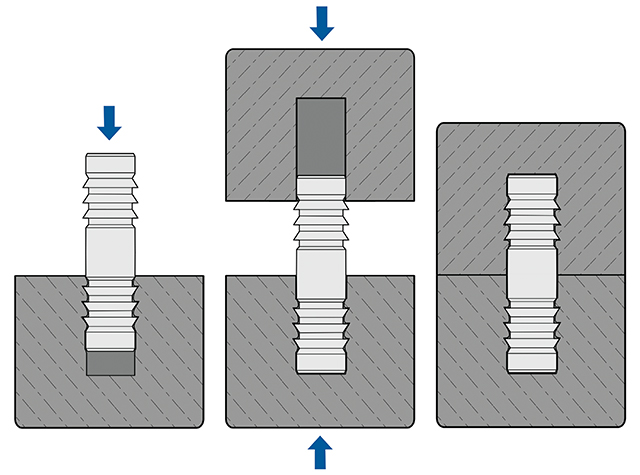
SPIROL’s Press-N-Lok Pin was designed to permanently retain two plastic components to each other, manufactured from lightweight, lead free, corrosion resistant aluminium
One major advantage of the pin is that assembly time is quicker and it requires lower assembly equipment costs when compared to screws and adhesives. This latest case study from the global fastener manufacturer explains how the pins helped a medical device manufacturer improve the assembly of its medical device handles.
THE PRIOR SOLUTION
A medical device manufacturer was using adhesive to join two halves of a plastic housing for a medical device handle. Although glue initially provided a practical joining method, it created several challenges during manufacturing. Precise dispensing was required to prevent excess adhesive, uneven bond lines, and cosmetic defects. In addition, the required curing time slowed production by creating delays and increasing work-in-process inventory.
The adhesive application also introduced inconsistency into the assembly process. Too little adhesive could reduce joint strength, while over-application could spread into surrounding features and require additional cleanup. As a result, the manufacturer sought a fastening method that would deliver greater process control, improved repeatability, and higher production efficiency.

To address these issues, the medical device manufacturer reached out to SPIROL for help identifying a fastening solution that would simplify assembly, support higher-volume production, and eliminate the limitations commonly associated with adhesive bonding.
THE SPIROL SOLUTION
SPIROL Engineering recommended Press-N-Lok Pins as the ideal solution for the medical device handle. Specifically designed for plastic applications, Press-N-Lok Pins allow for quick, controlled installation, making them particularly well suited for high-volume medical device manufacturing environments where consistency and cycle time are critical.
Press-N-Lok Pins allow for quick, controlled installation, making them particularly well suited for high-volume medical device manufacturing environments where consistency and cycle time are criticalJake Raymond, SPIROL
Unlike adhesives that require careful application and curing, Press-N-Lok Pins are installed through a straightforward press-in process that provides immediate retention. This eliminates cure-time delays and helps streamline production operations. Because the retention is mechanical rather than chemical, the assembly method becomes more predictable and less dependent on operator technique or adhesive variability.

Press-N-Lok Pins securely join the plastic housing halves while supporting a clean, efficient assembly operation. Transitioning from adhesive bonding to a mechanical fastening solution also enabled the manufacturer to reduce process complexity, improve line productivity, and minimise the risk of assembly defects associated with inconsistent adhesive application.
THE RESULT
By replacing adhesives with SPIROL Press-N-Lok Pins, the medical device manufacturer improved assembly consistency, increased throughput, reduced process variation, and achieved a more dependable fastening solution for its medical device handle.
Jake Raymond is at SPIROL. www.spirol.com