Conflux Technology specialises in high-performance 3D-printed heat exchangers
When former F1 design engineer Michael Fuller decided to apply his F1-grade mindset to road cars, he couldn’t have predicted how satisfyingly he’d be able to prove his new technology concept in the real world
In 2015 Fuller founded Conflux Technology, an advanced manufacturing company specialising in high-performance 3D-printed heat exchangers, in Geelong, Australia. By 2025, the company, via partnerships with several high-profile automotive players, was able to announce some astonishing results in 3D printed thermal innovation. As the Australian innovator explains, one notable highlight is a project with Dutch sports car manufacturer, Donkervoort, on its soon-to-be-unveiled P24 RS supercar: “We engineered a pair of ultralight water charge air coolers using computational fluid dynamics (CFD)-driven fin geometry, density and flow paths tuned to the P24 RS, cutting weight to about 1.4kg per unit [compared with 16kg for traditional systems] and enabling shorter intake routing, sharper throttle response and superior cooling versus the brief’s target.”
Fuller reveals that exceeding the already challenging brief had a positive knock-on effect: “Our approach was so effective that Donkervoort was able to further downsize the initial prototype package, contributing to the company’s lightweight design ethos.”
Detailing the method behind these impressive results, Fuller says: “Metal additive manufacturing (AM) enables us to create gas-tight, thin walls and complex, evolving internal channels that conventional methods can’t produce, while eliminating tooling so rapid design iterations move at CAD speed, enabling us to deliver F1 grade cooling performance for high-performance road cars.”
ITALIAN EXCHANGE PROGRAMME
Another example of such work can be found within a successful six-year partnership to integrate Conflux’s 3D-printed heat exchangers in the Pagani Utopia hypercar transmission – delivering a model that’s 30% more efficient than conventional designs. “We achieved the 30% heat rejection gain by replacing the incumbent with a drop-in cartridge heat exchanger featuring optimised coolant inlet/outlet geometry, our proprietary fin designs and ultra fine 0.26mm fin gaps to improve flow distribution and reduce oil side pressure drop, all within the original transmission envelope,” explains Fuller, who has recently transitioned from Conflux’s CEO to executive chairman.
Commenting on the design process, Fuller says: “The development spanned several months with up to eight full-size prototypes, underpinned by extensive CFD to balance heat rejection against pressure losses. The parts were validated through ISO 17025 thermal-fluid testing, 15,000km of road/track trials and non-destructive inspections using ANSTO Synchrotron (Australia’s synchrotron) for durability.” And how did additive manufacturing speed up this work? “Metal 3D printing removed tooling constraints, enabling rapid, low-risk design iterations and precise internal geometries that conventional manufacturing cannot produce, accelerating prototyping while delivering step-change performance without rearchitecting the transmission,” confirms Fuller.
DEMAND-DRIVEN DEVELOPMENT
Having achieved such remarkable technical achievements does Fuller feel we have now reached the pinnacle of heat transfer technology for road cars? On the contrary, he says: “We’re just getting started! As the industry pivots to hybrids, mainstream demand for compact intercoolers, oil coolers and power electronics thermal hardware is increasing and manufacturers are seeking solutions where tooling free iteration wins on both performance and time to market.
“With structural cost declines happening in metal AM, our F1-grade cooling technology becomes accessible to general automotive in the near future, especially as OEM hybridisation and higher under bonnet heat loads intensify. The next evolution couples thinner, pressure capable walls and finer fin features with AI assisted CFD. We’re actively compressing our design test loops and scaling our capabilities to support volume production,” he details.
As well as growing the automotive side of his business, Fuller is also focusing on the increasing demand for his solutions from other sectors. He explains: “We already support aerospace, defence and industrial applications where heat flux and footprint constraints are extreme. The biggest bottlenecks are showing up where power density and packaging collide, such as data centres/server racks, EV power electronics and batteries, hydrogen/fuel cell and avionics cooling, and compact industrial systems. Conventional heat exchangers hit limits on pressure drop, size and supplier responsiveness. That’s why enquiries keep arriving from every direction; the heat exchange problem is ubiquitous, so we prioritise focus, helping all customers meet higher heat rejection targets in tighter envelopes while maintaining a clear path from prototype to series production.“
Fuller is exploring a number of options as part of Conflux’s own scaling journey, including licensing some of its technology. “Conflux Production Systems (CPS), our manufacturing model for additively manufactured heat exchangers, will be available to our customers as a licensing option. Select partners can deploy a CPS line within their own facilities under our qualification, process controls, and QA/cleanliness regimes to scale production closer to final assembly,” he explains. “We remain open to strategic co development and long term supply across automotive, motorsport, aerospace, space, defence, and industrial sectors, using CPS licensing where it accelerates adoption, de risks logistics, and supports distributed, compliant manufacturing,” he adds.
STEEL CITY SITE
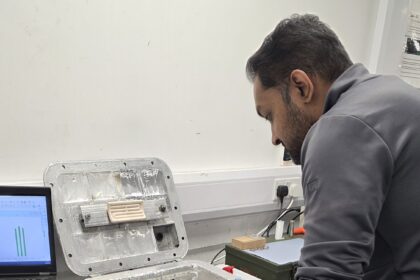
Conflux has recently opened a UK facility in Sheffield. On this, Fuller comments: “Europe accounts for over 35% of our business, so Sheffield gives us local, same time zone support and proximity to key programmes. The site will initially expand our in house testing (including two phase heat exchange) and drive product and material parameter development, with tighter collaboration cycles alongside European customers and programmes such as TheMa4HERA (an EU Clean Aviation program to develop hydrogen-electric regional aircraft).”
The UK site is also part of Fuller’s future-proofing plans: “As regional demand grows, we’ll scale the hub into our full Conflux Production System, enabling localised, resilient supply chains for our customer’s heat exchangers. This roadmap lets European partners move faster into production using commercially available production equipment.”