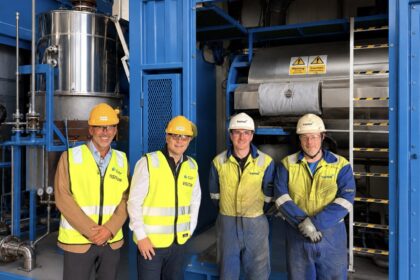
The programme was conducted in partnership with ORE Catapult and RWE
Results from a testing programme from the Offshore Renewable Energy (ORE) Catapult and wind power company RWE show how turbine blade lifespans could be significantly extended
Some of the earliest models of wind turbines are approaching the end of their intended operational lifespans; however, the programme results highlight possibilities that could extend the life of existing blades by up to half of their expected lifetime again in some cases, meaning operating wind farms could continue to generate clean power for longer.
Sally Poxon, principal validation engineer at ORE Catapult, said, “With hundreds of wind turbines, both onshore and offshore, approaching the end of their planned life cycles over the next few years, it’s important that we understand more about how to potentially extend the life of turbine blades. This is a vital part of making sure we have a clear route to meeting the UK’s clean power and net zero targets."
Poxon added, “By working closely with colleagues at RWE, we applied real-world physical testing to a blade which has already seen 20 years of operation and aged it dramatically to test a variety of different technical solutions and monitoring techniques. This process meant we were able to provide RWE with findings that allow them to make informed decisions about how to extend the life of the blade. We believe this could be a breakthrough moment for the wind industry, and one which further underlines the value and importance of this type of bespoke physical testing.”
Jessica Woodhall, RWE head of operations strategy and optimisation, said, “This groundbreaking testing programme by ORE Catapult and RWE marks a significant milestone. By demonstrating the potential to extend the lifespan of turbine blades, we can unlock substantial benefits, including increased energy production, reduced maintenance costs, and enhanced sustainability. This innovation can help us maximise the value of our existing assets and support the growth of renewable energy.”
The physical blade testing was conducted at ORE Catapult’s test facility in Blyth and focused on a blade which had already been in operation for 20 years at one of RWE’s harshest onshore wind sites, meaning the blade had already endured significant natural wear and tear.
ORE Catapult engineers replicated real-world conditions that a 20-year-old turbine blade would face and accelerated the ageing process in a controlled environment as part of the test. The team successfully replicated one year of real-world impact every 48 hours, enabling the application of equivalent stress and strain on a section of the blade. This allowed the team to test the effectiveness of different solutions in prolonging its operational life.
The testing demonstrated that applying specific adaptations and solutions made it possible to extend a blade's operational life. RWE intends to use the findings for ongoing life-extension assessments across its wind fleet and will share its learnings across its broader business.
A key contributor in the testing was UK-based blade monitoring specialist Eleven-I, which Onyx Insight recently acquired. Their approach utilises software, sensors, and data analysis to monitor blade health throughout its lifetime. This was applied to the blade during the test, providing a comprehensive understanding of how to extend its operational life.
Dr Philip Shackleton, principal engineer for blade sensing from Onyx Insight (formerly Eleven-I), said, “Working with ORE Catapult provides unique opportunities for industrial collaboration in the space of emerging technologies, such as for our blade condition monitoring hardware and analytics. Our vision is for whole-life blade monitoring that can deliver benefits to the widest range of wind energy stakeholders, and end-of-life/lifetime extension is a key period in that wind turbine blade life cycle. To be able to participate in this joint project between ORE Catapult and RWE on accelerated lifetime extension testing was therefore invaluable for further validation of our analytics techniques and theories."
Shackleton added, “By monitoring the blade over the subsequent years of simulated operation, accrued in just several weeks, allowed us to clearly see the effects of ageing on the blade structural response – a proof that would be impracticable to achieve through in-field monitoring alone. The outputs of the analytics used and further developed during this project not only provide additional insight into the effects of fatigue on the blade structure but also demonstrate the potential benefits of in-service monitoring of life extended blades. By understanding how a blade response is expected to change with extended operation, 24/7 reassurance can be provided on the blade structural health, while other mitigations such as costly and intrusive inspections can be reduced.”