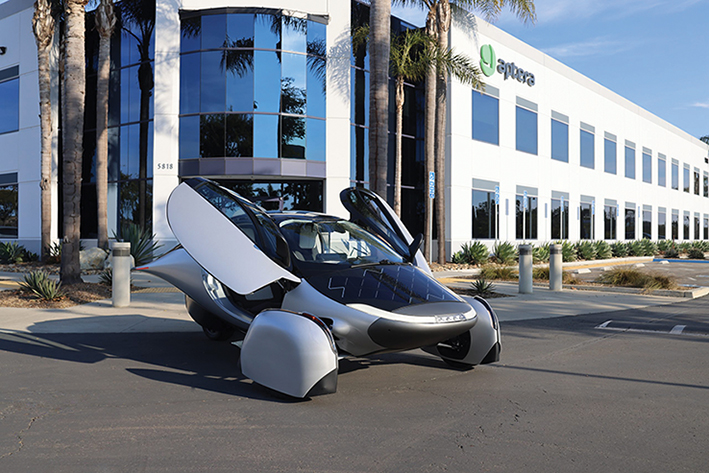
The latest Aptera validation vehicle is putting the proof in the pudding after breaking new ground in vehicle efficiency
Could the future of electric transportation run on solar power? The latest Aptera validation vehicle is putting the proof in the pudding after breaking new ground in vehicle efficiency
Pre-production startup Aptera Motors imagines a future where every journey made is powered by the sun. An ambitious goal, sure, but what might sound like a pipedream to some is backed by over 34 patents, nearly 50,000 reservation holders and a potential revenue of $1.7 billion, with the firm’s validation vehicle – Aptera – well on its way to entering production.
“The idea for Aptera was born out of a fundamental question: What if an electric vehicle didn’t need to be plugged in at all?” Says Quincy Hilla, Aptera’s head of marketing and PR. “Our co-founders, Chris Anthony and Steve Fambro, realised that most electric vehicles are still heavily reliant on the grid – which often still depends on fossil fuels. So, they set out to build something radically different: a vehicle so efficient it could be powered by the sun.”
In a snapshot, the Aptera promises up to 40 miles of free solar-powered driving per day, 400 miles of range per full charge, and 0-60mph in less than six seconds. But this all begins with efficient design, says Hilla.
“Instead of adding bigger batteries or more charging stations, Aptera flips the equation by starting with extreme efficiency – which means less energy is needed to begin with,” Hilla explains. “That opens the door for integrated solar power to carry more of the load. Our goal is to give people the freedom to drive without ever needing to plug in, depending on where they live and how they drive. It’s not just a cleaner solution – it’s a more empowering one.”
HOW DOES IT WORK?
Aptera’s integrated solar package includes up to 700W of solar power throughout the body of the vehicle – including the roof, dashboard, hood and rear hatch. This allows the vehicle to harvest sunlight throughout the day and convert it directly into electricity to charge the battery.
“In ideal conditions, that can provide up to 40 miles of range per day from solar alone – more than many people drive daily,” Hilla says. “Even in less-than-perfect weather, our solar panels still generate meaningful range, helping to reduce or eliminate the need for charging.”
The design begins with Aptera’s completely rethought vehicle platform. The vehicle’s aerodynamic shape coupled with its ultra-high-strength and lightweight carbon fibre body structure enables the vehicle to achieve meaningful range via solar energy. The streamlined, teardrop shape reduces air resistance to deliver one of the lowest drag coefficients of ‘any vehicle ever made’.
“Aptera’s unique design is driven entirely by physics,” Hilla says. “It’s built with an ultra-lightweight composite body, enclosed wheel covers and an aerodynamic teardrop shape – resulting in a targeted drag coefficient (Cd) of just 0.13, the lowest ever achieved in a production vehicle. This enables Aptera to travel up to 400 miles on a single charge with a relatively small battery – because we lose less energy to drag and weight.”
From a safety perspective, Aptera is built with high-strength carbon fibre materials and energy-absorbing metal subframes to enhance impact resistance. Its front nose cone and subframe are engineered to crumple against an angled firewall, extending the impact sequence to protect passengers
“We also use composite materials in the body structure, which not only reduce weight but increase strength,” Hilla adds. “Our monocoque body design allows for excellent crash protection without the need for heavy steel frames. Safety, strength and efficiency are all integrated by design.”
In terms of benefits, Aptera could enable energy independence for drivers, who may never need to plug into the grid to charge their vehicle. In turn, this would lead to lower energy costs, fewer charging sessions, and less charging infrastructure required. Reducing dependence on the grid would also have sustainability advantages and help to cut overall emissions. From a driver perspective, convenience would be a big factor, removing the hassle of waiting at chargers or worrying about range for typical daily driving.
TESTING BREAKTHROUGH
At the end of February, Aptera Motors put its first production-intent validation vehicle to the test in the Mojave Desert in order to validate its core efficiency under real-world conditions. The company conducted coastdown testing to measure Aptera’s aerodynamic, rolling and powertrain losses. The vehicle took over three minutes to decelerate from 60mph to a complete stop, even while travelling uphill. Based on the firm’s calculations, this coastdown distance is significantly more than any other vehicle on the road today, whether diesel or electric.
The company also performed several other tests, such as aerodynamic tuft testing to the wheel fairings and vehicle gaps, and extended highway drive cycle testing while precisely monitoring energy consumption. According to Aptera, the tests confirmed that the vehicle was on track to achieve its target energy consumption of roughly 100Wh/mile.
WHAT’S NEXT?
Development is already underway on Aptera’s next validation vehicle, and will include refinements to key areas such as improved fit and flush around vehicle gaps, and a design-intent weight profile using optimised parts. Once these have been fleshed out, the team will return to the track for another round of testing, including a full range test where the vehicle will be driven from a fully charged battery all the way to 0% to confirm the vehicle’s efficiency and range. The company’s engineers will also measure and validate the vehicle’s real-world solar charging capabilities to confirm its daily solar range estimates.
“Right now, we’re preparing for low-volume production to begin in late 2025, with full-scale vehicle production planned for 2026,” says Hilla. “Our next major steps include finalising funding and supply chain ramp-up, completing validation testing on our production-intent vehicles, and scaling our assembly capabilities and continuing to build out our team.”
With over 49,000 vehicle reservations from across the globe, Hilla believes this is a clear signal that people are excited about a more sustainable and efficient way to move.
“Aptera isn’t just about building a new kind of EV – it’s about rethinking transportation from the ground up, and proving that we don’t have to sacrifice freedom, performance, or sustainability to get where we need to go,” Hilla adds.