New technologies are changing the way aerospace manufactures build, inspect, and modernise their operations.
The aerospace industry is entering a new period of high-volume production, with Airbus planning to increase its A320 output from around 45-50 per month to 75 by 2026, and OEMs and suppliers around the world working to meet the demand. But with longstanding facilities, skills shortages, and rising pressure to decrease costs, the challenge is not just about modernising how aircraft are made but also about increasing output
Hexagon has created a portfolio of technologies to digitise production environments and automate quality assurance, including laser trackers and inspection cells, digital twins, and next-generation coordinate measuring machines (CMMs). These innovations provide a means to transform the way aerospace manufacturers can manage space, precision, and throughput.
AUTOMATING INSPECTION WITH ATS800
The Leica Absolute Tracker ATS800 is a portable laser tracker that can cut inspection times from hours to minutes and accurately measure from 40 metres away, without any scaffolding or targets. The ATS800 also makes the overnight “third shift” a reality on the factory floor.
By integrating reflector tracking with real-time feedback, high-precision tasks are simplified, including fuselage assembly and composite layups. At the same time, its FeatureDetect function can automatically recognise features from CAD files or panoramic camera feeds without the requirement for any manual programming.
The ATS800 is automation-ready and is able to be mounted on robot arms, gantries, or AMRs for lights-out inspections, fitting seamlessly into existing metrology software ecosystems, such as PC-DMIS and SpatialAnalyser. Having already been deployed in Hexagon’s automated PRESTO Quality Stations, the ATS800 has proven its ability to cope with large and complex structures with minimal repositioning, even on reflective surfaces.
DIGITAL TWINS FOR LEGACY FACILITIES
Inspection technology is taking on quality and throughput; facility modernisation is another vital part of the puzzle towards transforming aerospace production. Many aerospace plants have managed to evolve over decades, despite having to use layouts and data that no longer reflect operational reality. Hexagons Digital Factory-as-a-Service is able to address this by providing fast, millimetre-accurate 3D scans of production sites, transforming them into immersive, interactive digital replicas.
By using these digital twins, manufacturers can plan new production cells, test automation scenarios, and optimise space utilisation before any physical changes are made. The service can provide results four times faster than traditional mapping and can decrease travel and on-site meetings by up to 70%. It is also fully scalable across single or multiple sites, supporting traceability and digital twin strategies as aerospace companies scale up their production.
Nicolas Lachaud-Bandres, vice president of Industry Solutions at Hexagon, says, “With many factories adapted repeatedly over the decades, reliable layout data is often lacking. Digital Factory as-a-Service provides the clarity and control needed to modernise efficiently and ramp up without costly surprises.”
MAESTRO: NEXT-GENERATION CMM
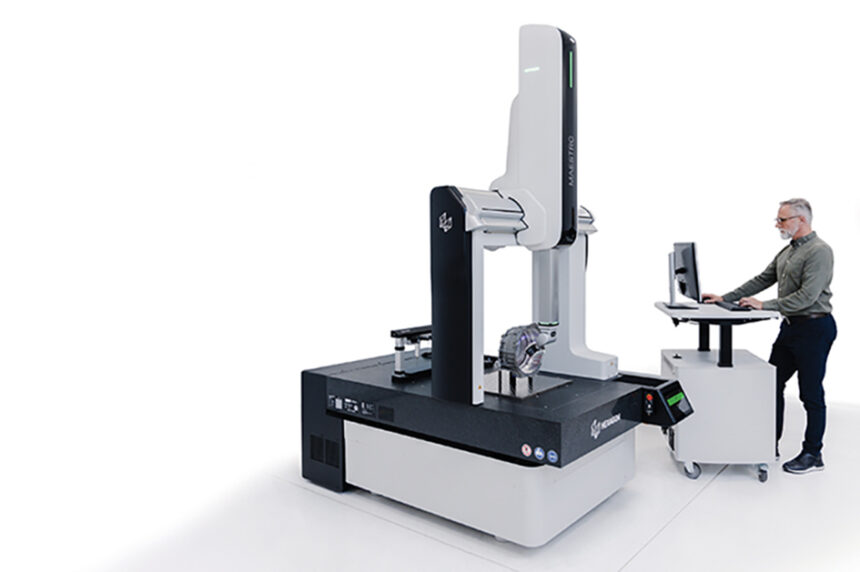
Maestro is a fully re-engineered coordinate measuring machine designed to meet modern manufacturing demands. Its digital architecture, which features advanced sensors, a single-cable system and new firmware, can provide sub-micron precision with speed, while also simplifying programming for experts and new operators through an intuitive interface and SaaS metrology apps.
Designed for IIoT integration via Hexagon’s Nexus platform, Maestro connects quality data across design and production teams, enabling data-driven decision-making. Its modular design ensures manufacturers can scale and upgrade as production evolves, making it a future-proof investment for high-precision aerospace applications.
Jörg Deller, general manager Stationary Metrology Devices, Hexagon’s Manufacturing Intelligence division, says, “By rethinking our hardware and software from the ground up, rather than iterating on existing systems, we’ve had the freedom to create a high-accuracy inspection solution that is so intuitive that anyone from experts to new hires are significantly more productive. Meeting the needs of industry head-on, Maestro’s digital backbone also makes it straightforward to integrate into modern connected factories, so stakeholders can improve quality quickly and definitively.”
PRESTO EL: SCALING UP INSPECTION CAPACITY
For the larger aerospace components, the Presto XL from Hexagon is the largest addition to its automated inspection cell range and has been designed for global deployment in just 16 weeks. The system can accelerate inspections by 50% and reduce hidden manufacturing costs.
Presto XL combines mobile trackers and scanners with Hexagon’s blue-line laser scanning and absolute positioning technology to enable quick inspection of large fuselage panels, doors, and wing ribs, even under challenging lighting conditions. It can be reprogrammed in hours by a single metrologist, without robot expertise, offering the flexibility aerospace OEMs require to keep up with rising output.
A UNIFIED VISION FOR AEROSPACE MODERNISATION
As a whole, the ATS800, Digital Factory-as-a-service, Maestro and Presto XL represent a coherent strategy to digitise and automate aerospace manufacturing. By combining real-time inspection, spatial intelligence, and next-generation metrology, Hexagon can provide manufacturers with the necessary tools to increase production without compromising precision.
As the aerospace sector prepares for its most significant production ramp-up in decades, technologies like these may prove essential in bridging the gap between legacy infrastructure and the smart factories of the future.