Sustainability: aviation’s fourth era
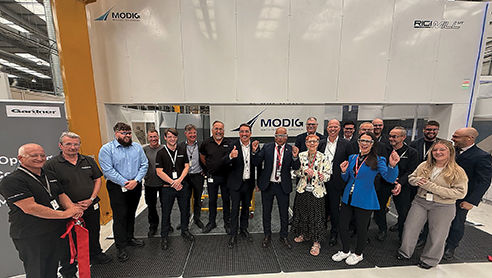
Addressing a professional audience from across the transport and aerospace sectors at Advanced Engineering, Philipp Visotschnig, CEO at Gardner Aerospace, set out a supplier-led perspective on aviation’s sustainability challenge, arguing that the next phase of aviation’s evolution will be determined as much by manufacturing, materials and data as by aircraft and engines
“We don’t build the aircraft. We build the parts that make flight possible with precision, reliability and partnership,” Visotschnig said, positioning Gardner Aerospace as a representative example of the deeply embedded global supply chain that underpins commercial aviation. With parts flying on nearly every major commercial aircraft, Gardner’s operations span Europe and Asia and support all major OEM platforms.
Visotschnig framed aviation’s development as four historic phases. “Since the Wright Brothers made their first flight in 1903 there have been four great steps in history of aviation,” he said, moving from making aircraft fly, to making them safe, then accessible, and now sustainable. “Now we are entering step four, perhaps the most demanding of all, make flight sustainable.”
STATE-OF-PLAY TODAY
Today’s aviation supply chain is vast and highly interconnected. Nearly five billion passengers fly annually on around 25,000 commercial aircraft operated by more than 100 airlines. Manufacturing is concentrated around Airbus and Boeing, supported by a small number of engine and systems suppliers and more than 1,000 parts and service suppliers. “An aircraft is one of the most complex products ever built,” Visotschnig said, highlighting the fragility of a system where a single out-of-tolerance component can disrupt an entire production line.
While aviation delivers undeniable economic and social benefits, it is also energy and material-intensive. Visotschnig emphasised that, “emissions are the problem, not aviation itself,” and argued that sustainability efforts must focus on improving the system rather than constraining it. Although the majority of lifecycle emissions occur during aircraft operation, the supply chain typically accounts for between 2% and 5% of total emissions. With more than 1,000 large commercial aircraft produced each year, this represents millions of tonnes of CO2 annually.
Gardner Aerospace’s own scale illustrates both the challenge and the opportunity. The company employs around 2,000 people across nine sites, producing more than 20,000 part numbers and delivering over two million parts per year. Visotschnig described an ongoing digital and operational transformation, stating: “For us, sustainability is not a project beside the business. It is how we run the business.”
THE PURSUIT OF NET ZERO
The aviation industry’s commitment to net zero by 2050 relies on three primary levers: more efficient aircraft, large-scale adoption of sustainable aviation fuel, and lighter, more efficient materials. Suppliers play a direct role in all three. Gardner Aerospace is supporting Airbus’s “Wing of Tomorrow” programme by manufacturing prototype components for next-generation lightweight wing structures. “It’s a concrete example of how suppliers, even suppliers beyond the tier one level, can play a role in advancing sustainability,” Visotschnig said.
He noted a broader shift in industry expectations. “Sustainability used to be a box ticking exercises, another audit, another report, that mindset is obsolete,” he said. Environmental performance is now a competitive metric, embedded in tenders and long-term agreements alongside cost, quality and delivery.
SUSTAINABILITY STRATEGY
Gardner Aerospace structures its sustainability strategy around three pillars: cleaner operations, smarter products and digitalised processes, and collaboration across the value chain. Energy use is the largest contributor to operational emissions. Four of the company’s nine sites are already largely solar powered, with a rollout plan for the remainder. Smart energy management systems automatically power down idle equipment. “Despite a major production ramp up over the past few years, we have reduced our overall energy consumption by about 15%,” Visotschnig said.
Material efficiency is another focus. Aerospace machining typically removes large volumes of material, but Gardner’s aluminium recycling rate exceeds 98%. The company is now working with Airbus to create a closed-loop recycling system where scrap is remelted and recertified for aerospace use, delivering up to 95% carbon savings compared with primary aluminium production. “That’s circularity in action, and it’s happening today,” Visotschnig said.
Surface treatments are also evolving. Gardner has transitioned serial production to chromate-free processes, reducing chromate usage by 80% over the past decade. While technically complex, Visotschnig described the transition as irreversible.
Digitalisation underpins the second pillar. “You can’t manage what you don’t measure,” he said. By linking planning, machining, inspection and logistics, Gardner is creating a digital thread for every part, capturing process data and energy footprint. Future ambitions include verified carbon labels on individual components and real-time monitoring of sustainability metrics alongside traditional manufacturing KPIs.
The third pillar is collaboration. “Sustainability will only work if we align our flight path, not compete for altitude,” Visotschnig said, calling for standardised metrics, harmonised reporting and aligned incentives across OEMs, suppliers and regulators. He warned that administrative burdens risk slowing progress, particularly for smaller suppliers.
Finally, Visotschnig emphasised the human dimension. “No machine saves energy on its own. No process reduces waste without human insight and action,” he said. Gardner is embedding sustainability into training at all levels, empowering shop floor operators to drive continuous improvement. “That’s how sustainability evolves from compliance to culture, and culture is what keeps progress alive long after the project ends.”
Looking ahead to 2035, Visotschnig outlined a vision of fully renewable-powered sites, closed-loop materials, low-carbon logistics and a workforce proud of its environmental stewardship. “That’s not a dream. It’s perfectly achievable,” he concluded, framing sustainability as the defining challenge of aviation’s fourth great era.