How self-driving is progressing in oil and gas
AUVs are gaining increasing momentum as the oil and gas sector embraces the latest artificial intelligence advances. We take a closer look at two of the systems poised to revolutionise subsea inspections
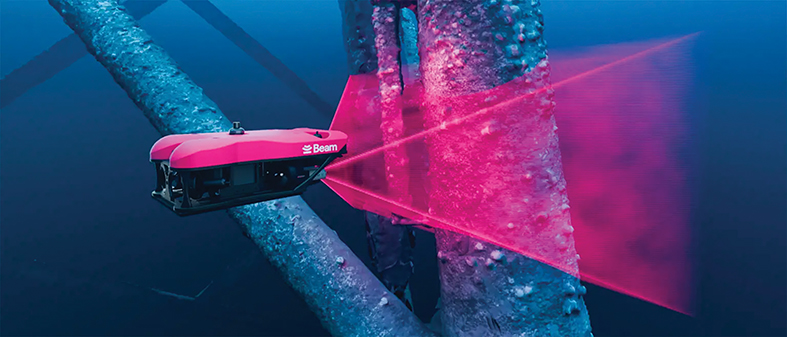
UK-based Beam first announced its AI-powered autonomous underwater vehicle (AUV) system – Scout – last year at Web Summit in Lisbon. Billed as a ‘world first’ at its unveiling, Scout promises to transform daily offshore operations with ‘groundbreaking autonomy’ when it launches 2025, says Beam.
Scout is said to be the world’s first AUV driven by AI, leveraging the technology to perform complex underwater tasks without human intervention. The system combines advanced AI, real-time 3D reconstructions and precise navigation to deliver subsea inspections that are both quicker and more cost-effective. Upon market launch, Scout could be deployed directly by people from existing crew transfer vessels (CTVs) during routine visits, enabling a wider pool of engineers to confidently manage subsea maintenance operations and alleviating the mounting skills gap in the offshore sector.
According to Beam, the Scout vehicle will open up a new way of conducting operations and remove the need for expensive third-party services, enabling once infrequent inspections to become routine management. Scout will enable 4K 3D reconstructions, such as year-on-year site comparisons, delivering engineers with unprecedented insights into asset integrity and structural health.
Scout will also significantly reduce the carbon footprint of subsea inspections as a result of lower fuel consumption and emissions associated with specialised underwater campaigns.
REMOTE CONTROL
Elsewhere, ocean services provider DeepOcean, along with its joint venture partners Solstad Offshore and Østensjø Rederi, has taken delivery of a newbuild uncrewed surface vessel (USV) which will be used for subsea survey, inspection, maintenance and repair operations across the offshore energy sector. At 24 metres long and 7.5 metres wide, the USV Challenger is equipped with a hybrid diesel-electric propulsion system and a battery package that allows the uncrewed vessel to operate for up to 30 days without charging or refuelling.
The USV will be remotely controlled from share and will be equipped with several autonomous features, capable of operating in severe weather conditions. The vehicle will house a fully electric work class ROV with hydraulic capabilities able to operate down to a depth of 1.5km, plus a large tool package that will allow the ROV to perform a wide range of subsea operations, such as pipeline surveys, seabed mapping and annual inspection work.
“Needless to say, the USV is fully capable of deploying offshore and conducting subsea operations independently. However, it can also serve as a highly cost-effective supplement to larger subsea vessels,” says Øyvind Mikaelsen, CEO of DeepOcean. “Rather than mobilising large vessels for every offshore task, operators can leverage the USV and its onboard ROV for parts of subsea installation, survey, or IMR scope. By reducing the need for repeated transits of larger vessels, the USV offers significant cost savings. The value proposition is clear – the USV represents a more economical and efficient alternative for a wide range of offshore operations.